
There is a kind of programming that rarely gets mentioned in computer science classes. It is not glamorous. It does not involve inventing a new sorting algorithm or building a beautiful interface. We call it glue code, and in the modern API economy it is the exact place where your business is most likely to break.
As technologies mature, the core components become commodities. You do not write a database engine; Postgres handles that. You do not build a payment processor; you use Stripe. The hard part of modern engineering is not building the individual pieces. It is making ten external platforms talk to each other safely.
Key takeaways
- As core components commoditise (Postgres, Stripe), the value moves to the glue code that connects systems.
- Glue code has to solve three hard problems: domain translation, idempotency, and graceful degradation.
- Different platforms define the same entity differently, so an integration must map realities that disagree with each other.
- Idempotency (unique transaction keys) is what stops a retried webhook from shipping two orders.
- For AI agents, deterministic glue code is the guardrail that validates every model call before it touches your data.
Why is glue code where businesses break?
Because most developers treat integrations as simple data pipes. They write a function that takes a JSON payload from System A and pushes it to System B, it works on a laptop, and it ships. That is the trap. When you connect distributed systems you are not just moving data, you are managing distributed state across networks you do not control. Good glue code has to solve three genuinely hard problems.
How do you sync systems that disagree about reality?
You do domain translation, and you enforce it exactly. Every SaaS tool has a different assumption about the world: Stripe thinks a "customer" is a payment entity, Salesforce thinks a "customer" is a sales-pipeline entity, and your own database thinks a "customer" is an authentication record.
When you sync these systems and the mapping is not exact, you get orphaned billing records and silent data corruption. Glue code has to enforce business logic across boundaries that disagree with each other, which is far harder than moving a JSON payload from one place to another.
How do you survive network failures?
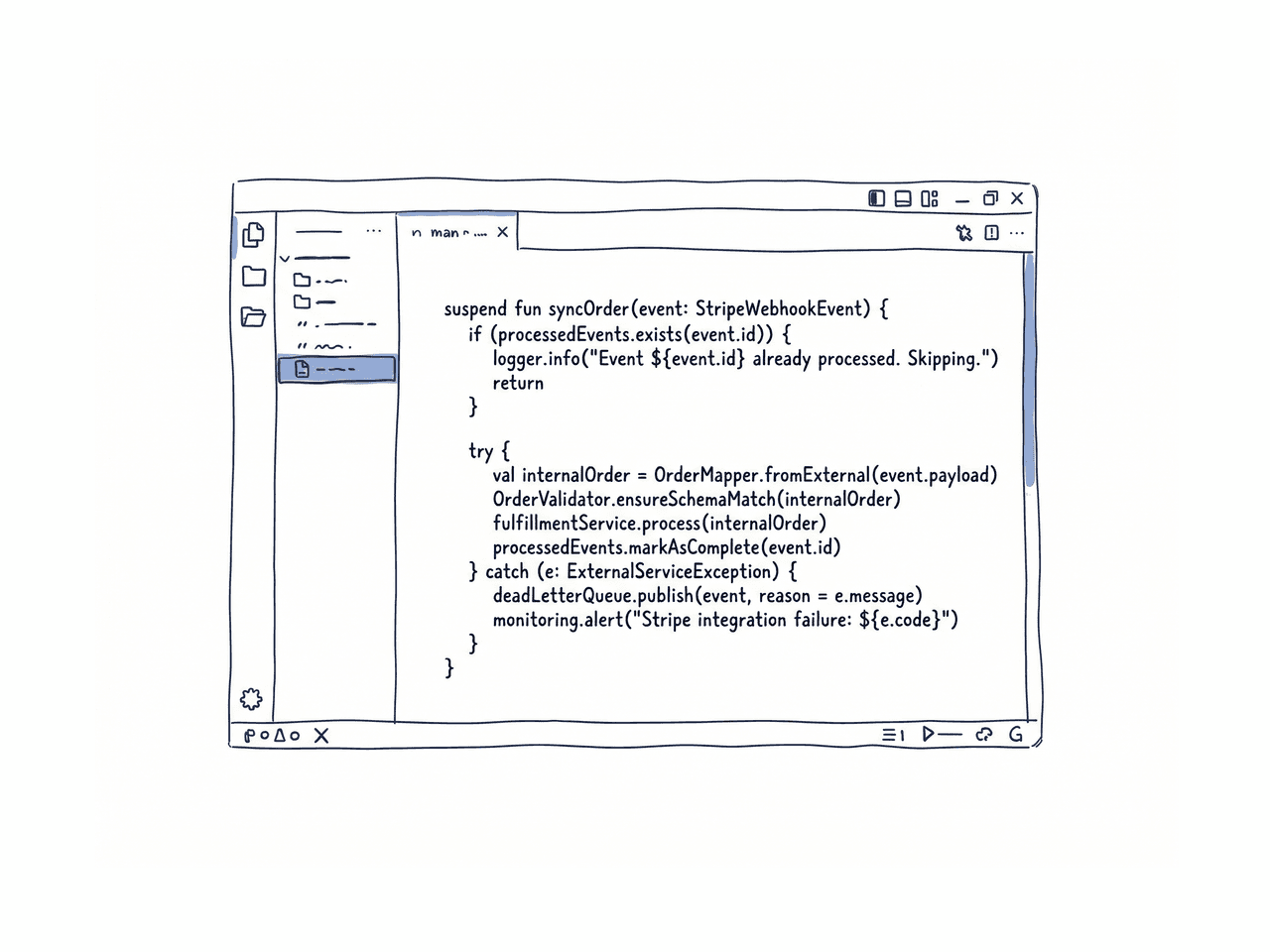
With idempotency. Networks fail, APIs time out, and webhooks arrive late. If a Stripe payment webhook times out, Stripe retries it a few minutes later, and naive glue code processes that retry as a brand-new event, shipping the customer two products instead of one.
Production-grade glue code uses a unique transaction key on every execution path, so that if a request is processed twice the system state changes once. It is unglamorous and completely load-bearing.
What happens when an external API goes down?
Resilient glue code absorbs the failure instead of passing it on. If the CRM integration fails, checkout should not crash with it. When a third-party service returns a 500, our code catches it, places the task in a dead-letter queue, and alerts the monitoring stack. The main application keeps running, and the failed task retries automatically with exponential backoff once the service recovers.
Why does this matter even more for AI agents?
Because language models are non-deterministic, and the glue code is the only deterministic guardrail you have. A model will occasionally produce a wrong or malformed call. The only safe way to deploy one is to wrap it in rock-solid glue code, using a contract like the Model Context Protocol (MCP), that validates every request against a strict schema before it is allowed to touch your database.
The best engineers in the industry are not the ones rewriting standard libraries. They are the systems architects who can wire a fragile web of APIs into a single reliable engine, one that never drops a task, never duplicates an order, and never fails silently.